Kakobuy Climbing Harness Evidence Review
Kakobuy Climbing Harness Evidence Review
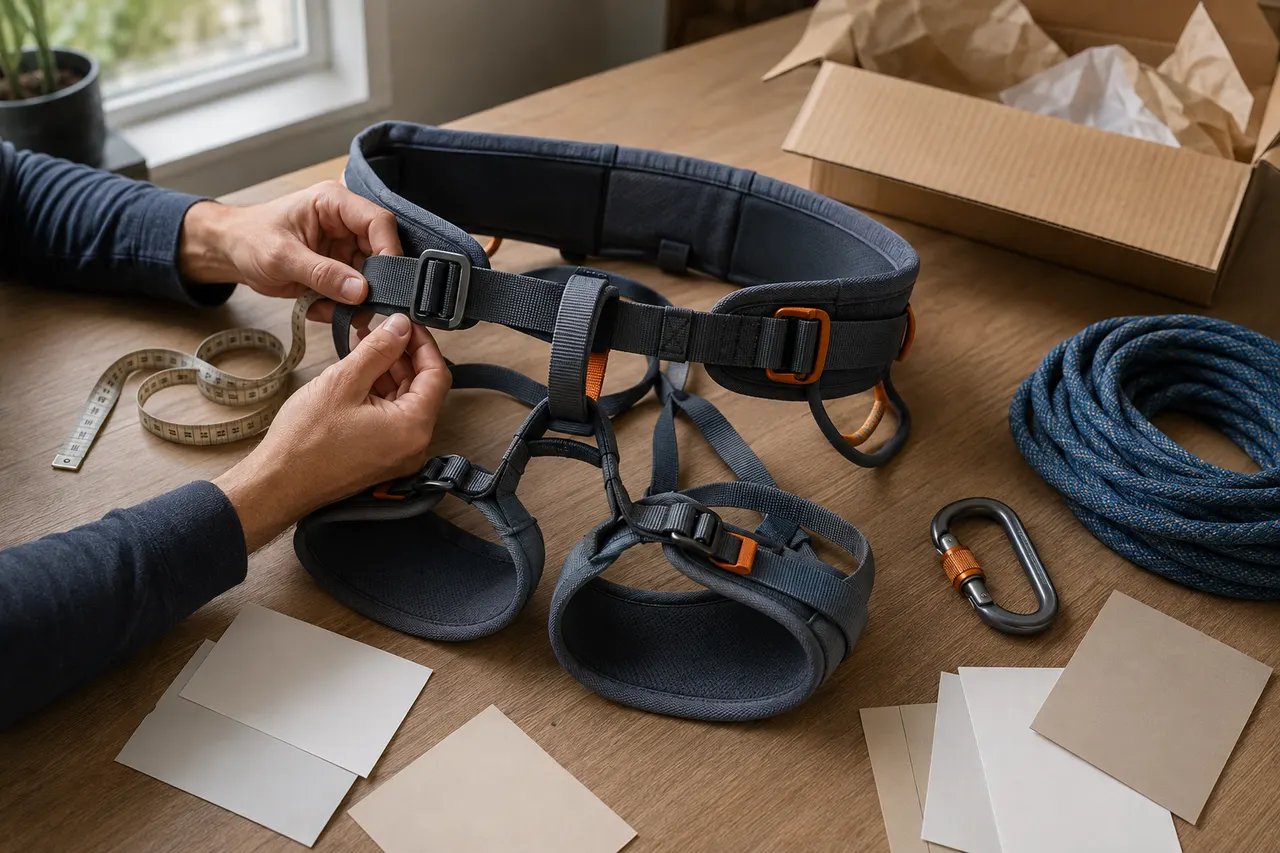
Verification date: September 3, 2026
Climbing harnesses are personal protective equipment. Warehouse photos can help buyers spot wrong sizes, damage, and obvious workmanship anomalies, but they cannot prove that a harness meets a certain standard, nor can they verify the internal condition of webbing, load-bearing performance, or long-term reliability. The goal of this article is not just to pick a harness that "looks good" based on appearance, but to help you judge whether the current evidence is sufficient to place an order, whether you need to request additional photos through Kakobuy, and when you should simply give up on the purchase.
This article is intended for buyers who are checking product information and warehouse QC photos for full-body or sit harnesses. It does not apply to industrial work at height, fire rescue, professional protection for children, or equipment that has already been subjected to fall impact. Those uses require professional selection, document review, and retirement judgment specific to the scenario.
The harness purchasing questions this review aims to solve
The real question is not "Is this harness cheap?" but whether the seller's information, physical markings, and Kakobuy warehouse photos can together answer the following questions:
Can the specific model and size be identified, rather than just generic S, M, L?
Does the waist and leg loop size range cover the user's measurements when wearing actual climbing clothing?
What adjustment points do the waist belt and leg loops have, how do the buckles close, and do they require manual re-threading?
Can the belay loop, tie-in points, gear loops, and load-bearing webbing be clearly distinguished?
Can the manufacturer, production batch, production date, service life, instruction manual, and applicable standards be traced?
Are the QC photos sufficient to rule out wrong items, cuts, mildew, contamination, severe skipped stitches, and missing parts?
After reading, you should be able to classify the order into one of three states: "Evidence sufficient, can proceed with further verification," "Need additional information or photos," or "Insufficient safety information, should not order." Safety equipment is not suitable for a "let's have it shipped and try it, and if it doesn't fit, we'll deal with it later" approach. ⚠️
Verifiable information, subjective judgment, and evidence boundaries
Evidence should be divided into three levels.
The first level is traceable documentation, including manufacturer and model, size chart, product manual, verifiable standard markings, production date, batch or serial number, service life, and recall inquiry methods. If the page only shows a certification icon without the corresponding model, issuing body, or document scope, that icon alone cannot prove compliance.
The second level is physical visible evidence, including clear photos of labels, buckles, waist belt, leg loops, belay loop, tie-in points, and key stitching. They can prove "what the received item looks like," but cannot prove material strength or dynamic fall performance.
The third level is subjective inference, such as "the webbing is thick, so it's safer," "the metal buckle is large, so it's stronger," or "the appearance is similar to a well-known model, so the structure is reliable." These judgments are not sufficiently grounded and should not be included in the purchase conclusion.
Kakobuy's role as a purchasing agent and warehouse inspector is suitable for verifying style, quantity, color, size, model, and obvious appearance issues, but warehouse appearance checks are not equivalent to laboratory testing or manufacturer certification. Sealed products may only allow inspection of packaging and appearance, so buyers should first confirm whether photos of the harness itself and labels can be obtained.
Judge size fit based on waist and leg loop information
Do not select a harness size directly based on everyday pants size. First, wear the clothing you might actually use for climbing, measure your waist circumference and left and right thigh circumference with a soft tape, and then compare each measurement with the official size range of that model. The measurements must fall within the waist belt and leg loop ranges; both are required.
A more reliable judgment method is:
Record waist and thigh measurements in two clothing states: base layer and winter clothing.
Find the size chart that matches the specific model and note whether units are centimeters or inches.
Check whether the measurements are too close to the upper or lower limit of the adjustment range.
Confirm whether the difference between left and right thigh circumferences is still within the adjustable range.
Request QC photos to clearly capture the physical size label and verify that the order option, packaging label, and harness label are consistent.
If the seller only provides height or weight recommendations without providing waist and thigh circumference ranges, the evidence is insufficient. If the size is at the boundary, do not guess that "the webbing might loosen a bit." Different seasonal clothing thickness, hanging posture, and activity needs will change the fit result. 🧗
After receiving the equipment, you still need to perform a wearing check according to the manufacturer's instructions. The waist belt should be in the position specified by the manual, and the adjustment tails, buckle closure, and leg loop tightness must meet the requirements for that model. Articles and photos cannot replace on-site try-on, partner check, or professional guidance.
Inspect adjustment buckles, load-bearing rings, and gear loop structures
First, mark each structure in the product images and QC photos, then determine whether the information explains its purpose.
Waist belt adjustment buckle: Confirm quantity, left/right positions, closing direction, and whether re-threading is required. A front photo of the buckle alone cannot confirm the webbing path.
Leg loop adjustment buckle: Adjustable leg loops are usually more adaptable to clothing changes but also add points that need to be checked each time; fixed leg loops rely more on precise sizing.
Belay loop: Should be identifiable continuously in front and back photos and correctly combined with tie-in points. Any cuts, obvious fuzzing, contamination, or abnormal deformation requires rejection or manufacturer judgment.
Tie-in points: Need to see the upper and lower tie-in points and their stitching clearly, not just display images obscured by a carabiner.
Gear loops: Usually used to carry quickdraws and other gear; do not assume they can bear human fall loads just because they look like webbing loops. Their purpose must be based on manufacturer's instructions.
Especially be wary of product pages with confusing structural names. If the seller calls gear loops load-bearing rings, or does not specify where the belay device and carabiner should be attached, the information is insufficient. Warehouse staff can take additional structural photos, but should not interpret the load path for the buyer.
Compare activity type and structural trade-offs with a table
Primary activity | Structures worth checking more | Possible trade-offs | Decision when evidence is insufficient |
|---|---|---|---|
Indoor sport climbing | Clear size range, easy-to-recheck waist buckle, identifiable belay loop | Simple structure does not mean labels and traceability can be omitted | Pause order and request model manual |
Outdoor single-pitch climbing | Waist-leg fit, number of gear loops, key tie-in point photos | More gear loops are convenient but do not mean higher safety level | Do not purchase if gear loops and load-bearing points cannot be distinguished |
Multi-pitch or traditional climbing | Long-duration hanging fit, gear distribution, adjustment margin | Wider support may increase weight and bulk | When only front display images are available, request multi-angle additional photos |
Winter or icy environments | Adjustment method with gloves, leg loop range, clothing compatibility | Increased adjustment range also adds more inspection steps | Do not infer suitability when low-temperature instructions are missing |
Industrial or rescue use | Certifications for the specific use, system compatibility documentation, professional selection records | Recreational climbing structures do not automatically meet occupational requirements | Do not use ordinary product pages as a substitute for professional procurement review |
This table only helps raise questions and cannot directly convert an activity name into a specific model. The final choice must still return to specific product documentation, user measurements, and manufacturer requirements.
Identify wrong size, damage, and stitching anomalies from QC photos
When submitting additional photo requests, each photo should address one specific question, rather than just asking for "a few more shots." It is recommended to obtain at least the following:
Overall front and back photos of the product, with all four corners in frame.
Waist belt size label, leg loop label, manufacturer and model markings.
Production date, batch or serial markings, and legible warning text.
Close-up photos of waist buckle and leg loop buckle front and back, with webbing path not obscured by hands.
Close-up photos of belay loop, upper and lower tie-in points, and surrounding stitching.
Left and right gear loops and all elastic connectors.
Instruction manual, accessories, and ordered quantity in packaging.
Key dimensions of waist belt and leg loops with a ruler placed alongside, only for checking received size, not as a substitute for official fit range.
When checking photos, look specifically for cuts, burn marks, obvious wear, mildew, oil stains, chemical contamination, webbing twists, abnormal skipped stitches, broken threads, large areas of loose threads, buckle cracks, sharp burrs, and asymmetry. Whether minor loose threads affect safety cannot be arbitrarily determined from photos; when uncertain, reject or obtain written manufacturer judgment.
QC photos also need to rule out photographic errors. Color differences may come from lighting, bending from positioning, and label blur from focus failure. In such cases, request additional photos rather than directly judging a blurry area as pass or fail. 🔍
Why you should not order when certification or usage history is unknown
The key risks of climbing harnesses often cannot be detected from appearance. Without production date and usage history, it is impossible to reliably judge aging, storage environment, chemical contamination, or previous load history. Second-hand harnesses with unknown origin, cut labels, or unrecognizable batches, even if superficially clean, should not be purchased as life-safety equipment.
If a product claims to comply with EN, UIAA, or other standards, you must further verify:
Whether the marking includes the complete standard name, number, and applicable version.
Whether the claim covers that specific model, not other products of the same brand.
Whether the manufacturer information on the product label, manual, and documentation is consistent.
Whether there is an identifiable notified body, test report scope, or declaration of conformity.
Whether the destination country, climbing gym, insurance, or organizational rules have additional requirements.
Standards and regulations may be updated, and should be rechecked through current manufacturer and relevant standards organization materials before publication and at the time of purchase. Marks printed on images may be misused or counterfeit, so "having a mark" and "verifiable" are not the same thing.
Inability to confirm certification does not mean the product is proven non-compliant, but it means the buyer does not have sufficient evidence to use it for fall risk. For such information gaps, the correct decision is to stop the purchase, not to use low price to compensate for uncertainty. ⛔
Organize an evidence checklist and request supplementary verification from Kakobuy
Before contacting Kakobuy, you can organize your needs into a checklist that can be answered item by item:
Please confirm the physical brand, full model, color, and size, and take separate photos of the order option, packaging label, and harness label.
Please photograph the waist belt and leg loop adjustment range markings, retaining centimeter or inch units.
Please photograph all buckles front and back, webbing threading direction, and adjustment tails.
Please take close-up photos of the belay loop, upper and lower tie-in points, and key stitching.
Please photograph the production date, batch, serial information, standard markings, and warning labels.
Please confirm whether the packaging includes an instruction manual and manufacturer information consistent with that model.
If damage, contamination, missing labels, model mismatch, or inability to take additional photos is found, please pause further shipping within the return/exchange period and provide handling options.
When submitting requests, do not send passports, payment cards, full shipping labels, or unrelated account information. Screenshots of orders should only keep the minimum fields needed for customer service to locate the product, and cover the address, phone number, and payment information. 🔐
For Kakobuy, a reasonable verification goal is to confirm the physical identity, size, quantity, appearance, and completeness of documentation, not to ask the warehouse to promise safety performance. If additional photos still cannot show the complete model, production information, key structures, or document sources, mark the order as "insufficient evidence" and prioritize applying for return/exchange, rather than continuing with consolidation and international shipping.
The final judgment can be summarized in four points:
Savings: Without verifiable specific product price, shipping cost, and alternative quotes, real savings cannot be calculated; apparent price differences should not be counted as realized gains.
Increased risk: Incomplete information increases risks of wrong size, structural misuse, lack of traceability, return/exchange costs, and personal injury, some of which cannot be eliminated by warehouse photos.
Suitable users: Buyers who can obtain complete manufacturer documentation, accurately measure body dimensions, and are willing to receive proper wearing instruction before use.
Situations not recommended: Certification or intended use unknown, labels missing, source or usage history unknown, key stitching cannot be clearly seen, size at boundary, or planned for industrial, rescue, and other professional scenarios.
This article was compiled by Panda-Buy Editorial Desk through an automated process and fact-checked according to evidence boundaries; it does not claim real-person purchase, wearing, or fall testing. Information involving specific products, platform policies, return/exchange deadlines, fees, logistics routes, and standard status must still be re-verified on the day of ordering through the corresponding platform, seller, manufacturer, and applicable institutions.
Browse our latest products and find your next favorite item.